July 1 to 15 (#13 of 2024)
This fortnight's issue arrives a little late, and without too many news items. I have changed the section title from News to On the radar, so I can include comments on podcasts or articles that are not specifically news, but were published during the fortnight.
Also, as you may have noticed in earlier issues, I tend to let the articles grow too long. From now on I am going to try to include only one long topic in each issue, and I will put it in a new section called In depth. It will also be a topic that arose during the fortnight, but one to which I devote a little more detail.
Thank you for reading me!
🗞 On the radar
1️⃣ The James Webb Space Telescope, JWST, has provided new data on LHS 1140 b, an exoplanet located 48 light years from Earth in the constellation Cetus. These findings, published on July 10 in an article in The Astrophysical Journal Letters, one of the most prestigious journals in astrophysics, reveal details about the composition of the exoplanet's atmosphere and the possibility that it may be a potentially habitable water world.
The press release published on July 8 by the University of Michigan includes an image showing a possible representation of the planet as a partially frozen world with a considerable amount of liquid water.
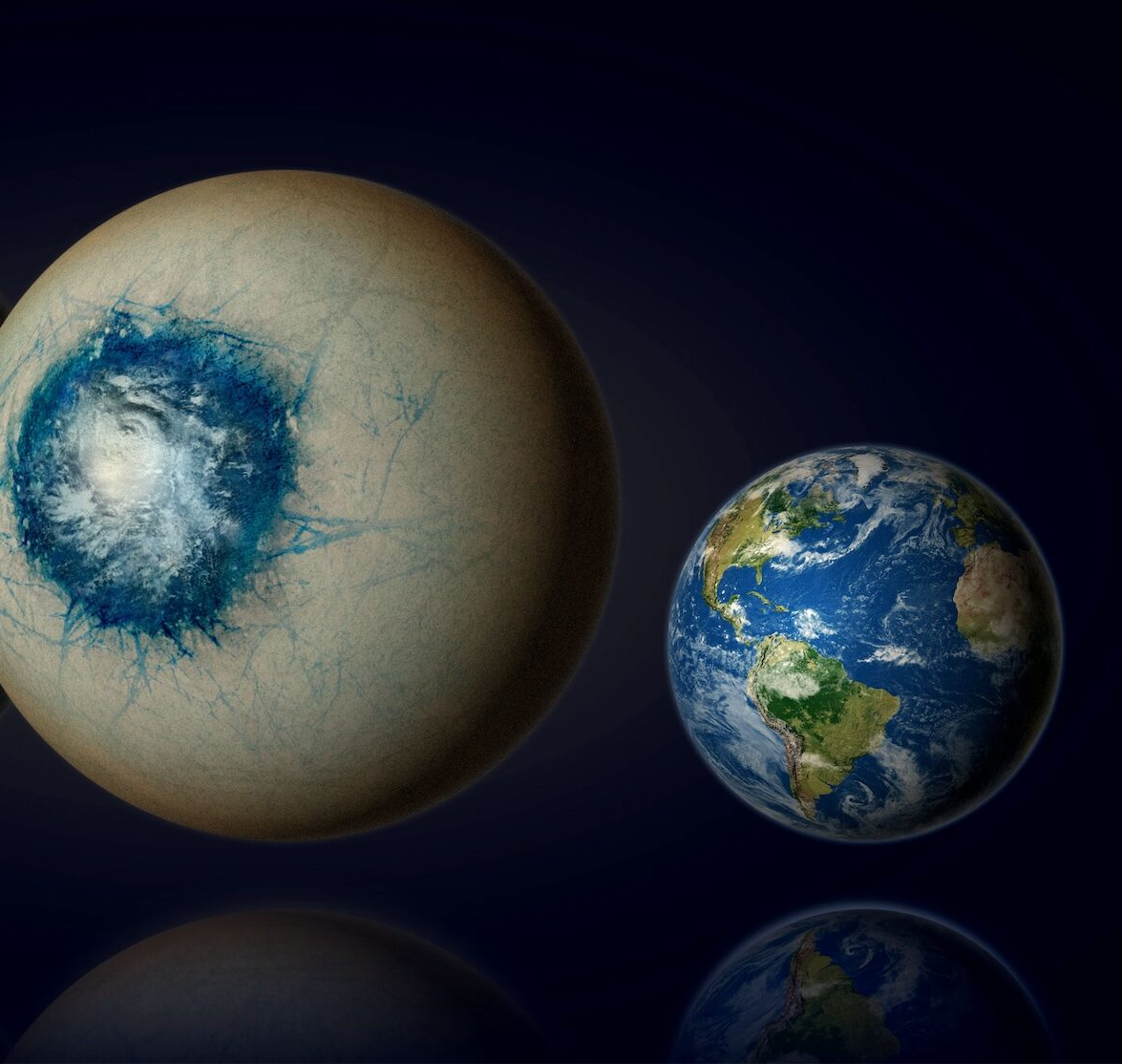
Possible representation of the exoplanet LHS 1140 b.
The study, led by Charles Cadieux and an international team of researchers, used JWST's NIRISS instrument, the Near-Infrared Imager and Slitless Spectrograph, to observe two transits of LHS 1140 b. This planet, with a radius of 1.7 Earth radii and a mass of 5.6 Earth masses, orbits in the habitable zone of an M4.5 dwarf star.
The habitable zone is the region around a star where temperatures are neither too hot nor too cold, allowing liquid water to exist on a planet's surface. The presence of liquid water is crucial because it is an essential requirement for life as we know it. In this zone, a planet receives the right amount of stellar energy to maintain moderate temperatures, which could favor the development of habitable conditions. This region varies depending on the type and luminosity of the host star. For a dwarf star like the M4.5 star of LHS 1140 b, the habitable zone lies closer to the star than the habitable zone around larger and brighter stars such as our Sun. The planet LHS 1140 b lies in that privileged zone, making it a prime target in the search for life beyond our solar system.
In the transmission spectrum resulting from the transit, certain atmospheric features of the planet can be observed. The most significant discovery presented in the paper is tentative evidence, at 2.3σ, of an atmosphere dominated by nitrogen. The authors used climate models to rule out a mini-Neptune-type atmosphere with greater than 10σ confidence. This indicates that the planet is not a gaseous planet, but rather a rocky super-Earth.
The paper discusses “water world” scenarios, suggesting that LHS 1140 b might contain between 9% and 19% of its mass in the form of water. For comparison, Earth's water mass fraction is less than 1%. But this still cannot be confirmed. New observations with other advanced JWST instruments will be needed in the coming years, allowing scientists to study and detect the presence of atmospheric CO2, which would confirm the existence of liquid water. The presence of liquid water would represent a necessary step toward the existence of life.
Will we be able to detect biosignatures on some exoplanet soon? The detection of molecules such as oxygen, methane, or an unusual combination of gases that would not normally coexist without biological processes, could suggest the existence of life. It is still early, but work like this gives us new clues and brings us a little closer to the momentous moment when we may be able to announce, with scientific confidence, the discovery of life beyond Earth.
2️⃣ The interesting New York Times podcast Hard Fork published, on July 5, an interview with Ted Sarandos, the CEO of Netflix. The interview is also available on the newspaper's website.
Netflix is a surprising success story, one that fascinated me from the moment it was born in the US. For me, the equivalents of the “iPhone moment” in the field of services have been Amazon and Netflix. They are companies that changed the world radically and took us into an “alternate universe” that might never have existed.
I remember the excitement I felt when Netflix arrived in Spain, about a decade ago. I was fed up with looking for series, not finding episodes, downloading them in poor quality, adjusting subtitles, syncing them... well, I am sure you all remember. Then Netflix arrived, opened the door to the whole streaming market, and established itself as the reference platform. And it made life much easier and more entertaining.
In the podcast, Sarandos talks about his beginnings as a clerk in a video rental store, just like Tarantino, and how that experience led him to Netflix, where he has been fundamental in transforming the company from mailing DVDs to becoming a global streaming giant.
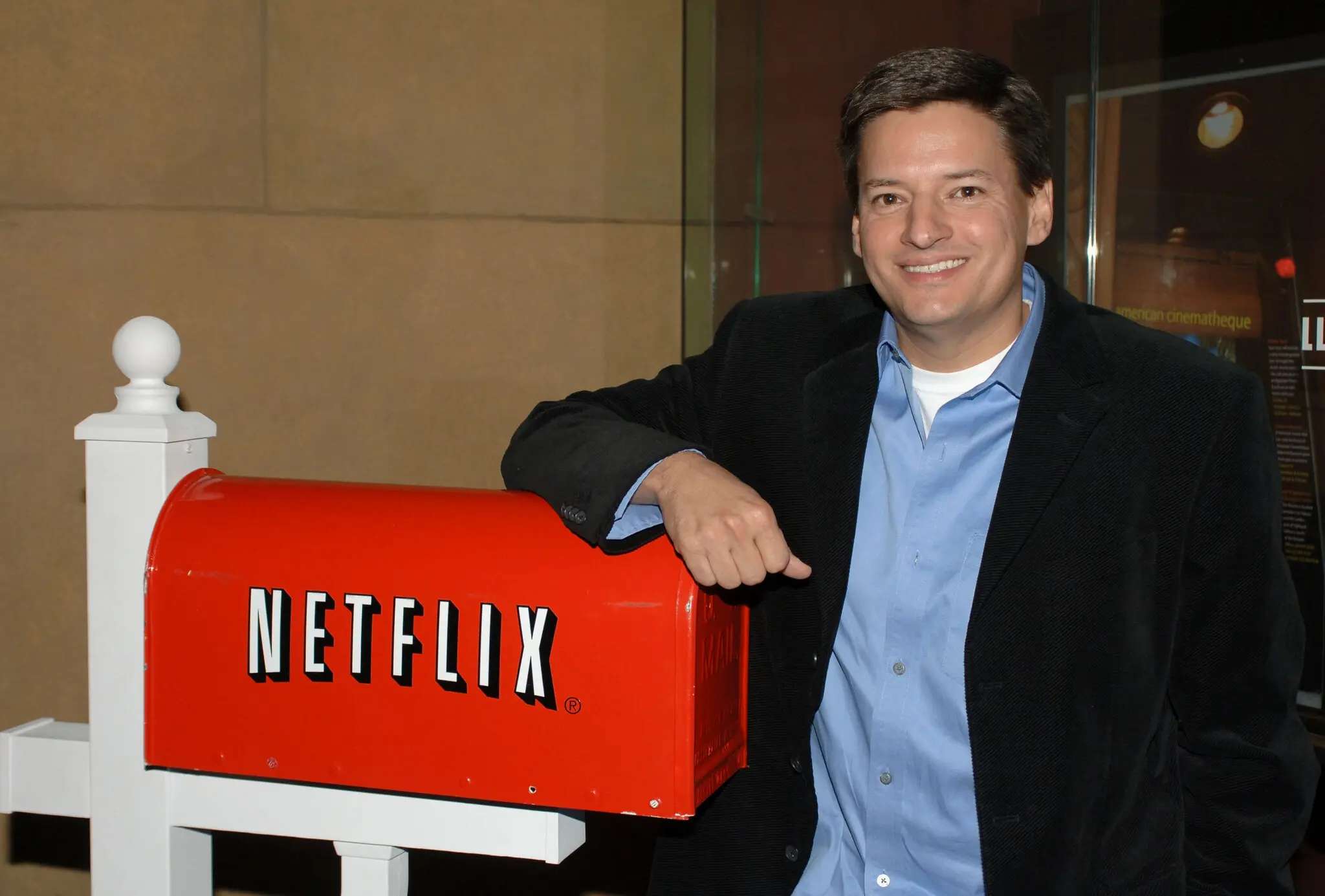
Ted Sarandos in 2005.
Throughout the interview, he discusses Netflix's content strategy, emphasizing the importance of authenticity and diversity in international productions, as well as the balance between quality and quantity in its programming slate.
Sarandos addresses several challenges and opportunities facing Netflix, including competition in the “streaming wars,” the introduction of advertising on the platform, and expansion into live entertainment. He also reflects on how Netflix navigates political and social issues, and on his view of the use of artificial intelligence in the entertainment industry. Throughout the conversation, Sarandos defends Netflix's “something for everyone” approach, arguing that quality is defined by the audience's love for the content, regardless of critics.
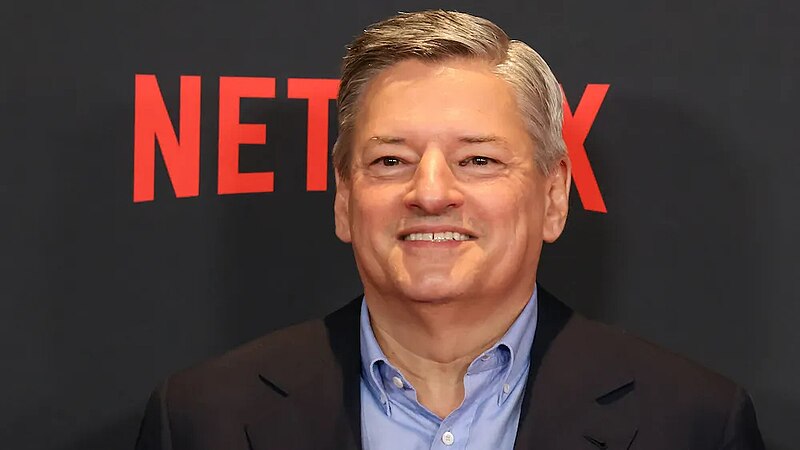
Ted Sarandos today.
Sarandos comments on one of the central elements of Netflix's successful model: content recommendation in a global market:
"I think we're entering a new era where content and great stories can come from just about anywhere in the world, and they can sit really conveniently on the shelf next to your favorite show. You can discover a great story from Korea, or a great story from Italy, or a great story from Spain that you otherwise wouldn't have access to and maybe wouldn't even know about, but that is the kind of storytelling that is really adjacent to the kind of storytelling you like."
The podcast concludes with Sarandos's reflections on the future of Netflix and of the entertainment industry more broadly. He discusses competition from free platforms such as YouTube and how the company maintains its focus on innovation and quality. And he ends with a reflection on the use of AI:
"I don't think there's a scenario where an A.I. program is going to write a better script than a great writer, or replace a great performance, or that we won't be able to tell the difference. A.I. is not going to take your job. The person who uses A.I. well might take your job."
3️⃣ It turns out that Hans Zimmer, the composer of soundtracks we have all enjoyed, Gladiator, Sherlock Holmes, Inception, Interstellar, The Dark Knight, Dune, is really Hans Zimmer Inc.
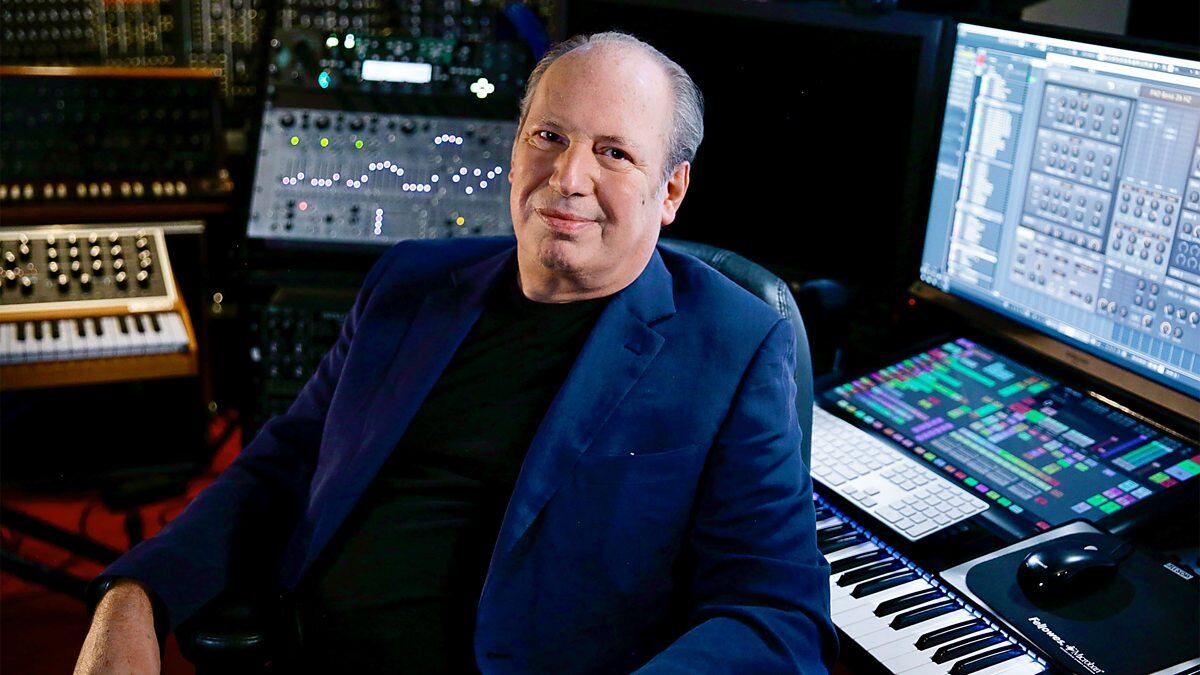
Hans Zimmer, in a BBC documentary.
On Eric Molinsky's podcast Imaginary Worlds, on July 3 they published the fascinating episode The Team Behind Hans Zimmer, which interviews musicians and sound technicians from Hans Zimmer's studio, Remote Control Productions.
The episode explores the unique way in which Zimmer and his team create the iconic soundtracks that have defined so many films. Zimmer's studio is described as a magical and collaborative place, full of analog and digital instruments, where every detail is carefully orchestrated in order to produce innovative sounds.
The episode goes deeper into Zimmer's creative process, highlighting how he gathers talented musicians and technicians to experiment and create new sounds, with special emphasis on their work for the film Dune. For Zimmer, what matters is not only melody, but also the search for specific sounds. That becomes quite clear in the following transcript of one section of the podcast:
Raul Vega: A few years ago Hans wanted to expand his percussion library. So he called us and said, “Hey, I want you to build me a drum kit.” So we said, “Okay, do you have a preferred drummer or a set of drums you want us to use?”
Hans said, “No, no, no, no, no. Let me rephrase this. I want you to build a drum kit out of found sounds. Take anything that is out in the yard, take anything that is in the alley, go to Home Depot and just play.”
Raul Vega: We went to Home Depot, bought some bricks and chains and a sledgehammer. And we put a bunch of microphones in the live room and took turns breaking things.
Taurees Habib: We just smashed it all up.
Raul Vega: Capturing only the definitive sound of destruction. Once they had those recordings clean, organized, and processed, it sounded like this.
[clip: sounds of destruction]
Raul Vega: Those are sounds of axes on two-by-fours, broken piano lids, chains, clay bricks. Now, for a long time, we had no idea what this was for, and I even think he did not know what it was for. So we kept it in our sound library for a very, very long time.
But years later, while working on Dune...
Raul Vega: He called us and said, “Hey, do we still have that?” I said, “I think so.” “Great. Send it to me.” So we assembled it, he mixed it, and then it became a very, very popular marching theme for Dune.
[clip: Dune Sketchbook - House Atreides]
Hans used these sounds in a version of the cue that plays when Paul and his family arrive on Arrakis.
The episode highlights the importance of collaboration in Zimmer's work, explaining how different musicians, sound engineers, and composers contribute to creating the complex layers of sound that characterize his scores. It details the innovative use of female voices, modified instruments such as the electric cello, and the creation of digital instruments from recordings of unusual sounds.
The episode is very much worth listening to. It is beautifully produced and gives us a unique view of how creative processes can be carried out as team efforts.
I will finish this part by linking a video by Jaime Altozano, as didactic as all the videos he makes, in which he reviews Hans Zimmer's professional career.
🔍 In depth
Now for the new section in which we devote a little more space to one of the topics of the fortnight. This fortnight we are going to comment on an article by Andy Matuschak about the Primer.
At the beginning of July, Andy Matuschak shared a post titled Exorcising us of the Primer. A few weeks earlier, on June 6, he had published it only for subscribers on his Patreon. What is this “Primer”? Who is Andy Matuschak? Why is this post relevant? Let us try to explain it.

Header image from Andy Matuschak's X account and Patreon page.
The subtitle of Andy Matuschak's Patreon page is Creating tools for thought. The expression tools for thought is used to describe the field of research and creation concerned with methods, technologies, and strategies designed to improve and expand our cognitive and learning capacities. Note-taking tools such as Obsidian, or spaced-repetition methods such as Anki, are examples of these tools.
This area of creation and research is directly linked to the development of computing and personal computers. The precursors of these ideas were researchers such as Vannevar Bush, with his famous article “As We May Think” (1945), Ted Nelson, who coined the terms “hypertext” and “hypermedia” in 1965, Douglas Engelbart, creator of the 1968 demonstration known as “the mother of all demos,” and Alan Kay, who developed the Dynabook concept in the 1970s. The web, personal computers, and the computational devices we have today are based on some of the ideas proposed by these visionaries1.
Andy's work, together with that of other researchers such as Michael Nielsen and Bret Victor, tries to capture the essence of those original ideas and apply them, making them real with today's technologies. It is striking that all these researchers are independent researchers who have developed their work outside academia and outside private companies. Private companies do not want them because the field is too speculative, and academia does not want them because the field is too novel and interdisciplinary.
All right, now we have the field of research in place. So what is this Primer? Let us get into it, through a personal story.
A few years ago I came across Cryptonomicon (1999) and Neal Stephenson. It blew my mind. The first thing I asked myself was how it was possible that I had not read it before. It had been published more than 20 years earlier, in 1999, and it dealt with cryptography, Alan Turing, World War II, and the Internet and electronic money, before Bitcoin. I should also have known Stephenson earlier, a prolific and brilliant writer who, as his Wikipedia page says, has written science fiction, speculative fiction, historical fiction, cyberpunk, and baroque works.
The thing is that after reading Cryptonomicon I got hooked on Stephenson and, looking for more of his work, I arrived at The Diamond Age (1995). The subtitle of the book was very curious: A Young Lady's Illustrated Primer. An illustrated primer? For young ladies? I read it, and found another wonderfully original book, full of ideas about nanotechnology, virtual reality, intelligent assistants, and the adventures of a humble young girl whom an intelligent book, the famous Primer, rescues from poverty and turns into someone powerful.
The idea of the Primer gave me a kind of inception, and I have kept it in mind ever since whenever I reflect on or read about educational tools. The same has happened to many others, as Andy comments at the beginning of the article:
[The Primer] is my field's most canonical vision for an incredibly powerful learning environment. If you ask a technologist interested in learning what they dream of accomplishing, most will answer, “build the Primer.”
So what is the article about? Why do we need to “exorcise” this idea? It is a long and detailed article that has to be read slowly, and more than once. Andy first explains how the Primer works in Stephenson's book and gives examples of interesting elements in the Primer. For example, the use of dynamic media, not only as didactic and motivating elements, but also as useful instruments that accompany the whole learning process:
The Primer’s nanomolecular microscope helps Nell get started with cellular biology, but it’s also a tool that makes expert biologists vastly more capable. It’s not a toy representation, a cognitive dead end Nell will need to discard as soon as she develops some intuition. It’s a tool that can grow with her into legitimate practice, a tool which in fact expands the frontier of practice for the whole field.
Despite these positive features, the Primer proposes a view of learning that Andy thinks must be surpassed:
-
Authoritarianism: the Primer has a hidden agenda and exerts excessive control over Nell's learning. That is immoral and ineffective if the goal is to develop independent thinkers.
-
Isolation: the Primer isolates Nell from meaningful purpose and from genuine human interactions, limiting authentic learning and connection with reality.
-
Excessive gamification: the idea of making learning always fun through games is unsustainable and cannot compete with games designed exclusively for entertainment.
-
Excessive discovery learning: although discovery learning can be valuable, it is not enough on its own and must be complemented by explicit instruction and structured practice.
With these arguments, Andy is criticizing many current approaches in educational innovation. I especially liked, and I share, his criticism of gamification and discovery learning, concepts that are very fashionable today.
Finally, Andy argues that we should leave behind the vision of the Primer and create a new learning environment that supports action and genuine interest. This new system must be integrated into the real world, offering dynamic and adaptive support that encourages immersion and emotional connection, but always with the goal of enabling authentic and meaningful participation in activities that matter to learners.
A system like this wouldn’t really be a “primer” any more, an isolated lesson to complete before real participation, useful only for beginners. It would be more like a general-purpose enabling environment, a tool for thought which would increase the probability and speed of learning-dependent action.
[...] This probably means some form of ubiquitous computing. My picture of that form is still pretty blurry, but you can see an early sketch of what a general enabling environment might be in my recent talk, “How might we learn?”.
While a tool like that is being built, I will keep using and experimenting with LLMs as learning assistants, to give me context and clarify concepts in the new fields I venture into.
👷♂️ My fifteen days
This fortnight we watched less cinema. Only a couple of films, and I gave all of them fewer than 4 stars on Letterboxd. I also did not make progress on my website, or on any project worth mentioning. So we are left with comments on a couple of series and on the book that I finally finished during the fortnight.
📺 TV
We watched the new season of Hacks on Max, and it continues to be just as good as the previous ones. Jean Smart as Deborah Vance and Hannah Einbinder as Ava Daniels are wonderful, dazzling in their versatility and in the range they bring to those complex characters. And they are surrounded by an equally magnificent supporting cast, and characters.

Very funny scripts, and a season that keeps growing episode after episode until it reaches a terrific finale.
And another series we liked quite a lot, Chapelwaite, also on Max. It is from a few years ago, 2021, and I had had it on my radar for a long time. First because it is about vampires and because it stars Adrien Brody. Then the series turns out to be much more than that. As Jorge Loser says in his review in Espinof, it is a story for lovers of old-school Gothic horror, with elements of H.P. Lovecraft, Stephen King, John Carpenter, and George A. Romero.
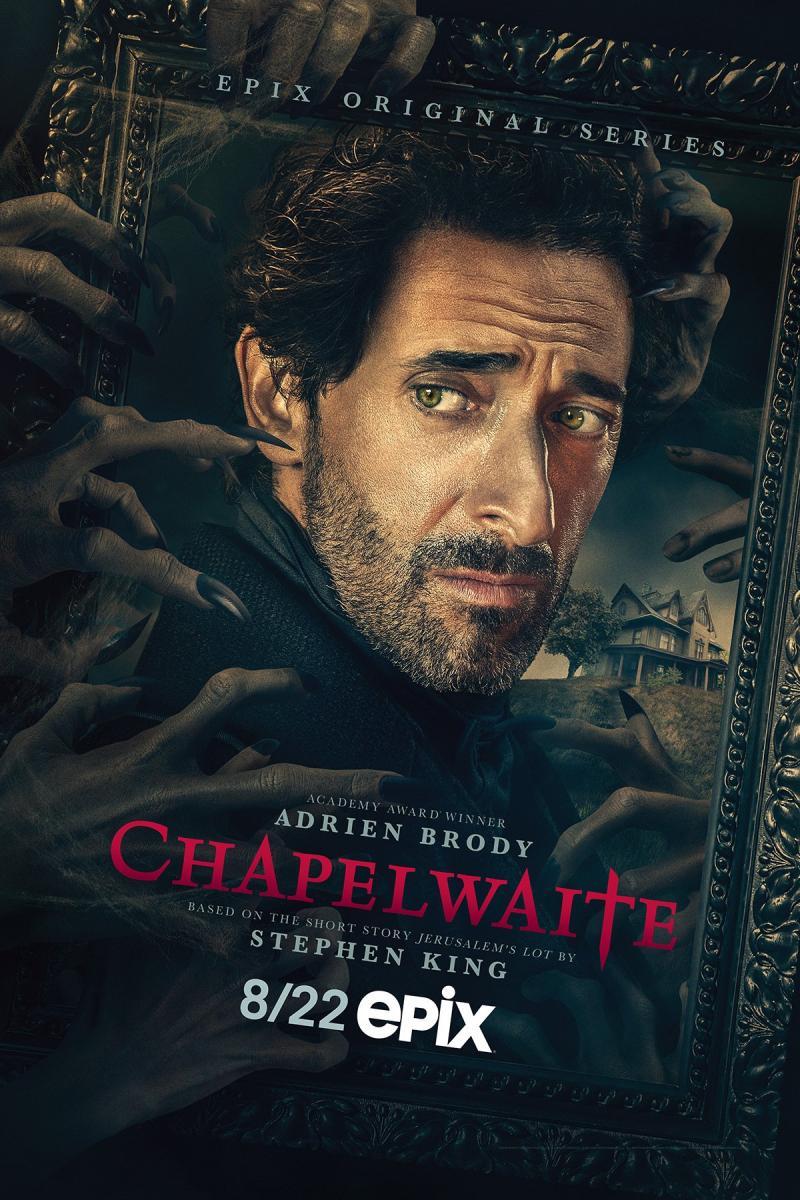
It is curious that in that same year, 2021, Mike Flanagan created the masterpiece Midnight Mass, which drinks from many of the same themes, but updates them to the present and gives a twist to the religious and existential aspects.
Flanagan's series immediately became my favorite series. Chapelwaite is more classical and has a somewhat weaker ending, but it touches on very interesting themes and develops them with a lot of style. Highly recommended.
📖 Books
I finally finished Dune Messiah, by Frank Herbert. I liked it just enough, I gave it 3 stars out of 5 on Goodreads. I am copying below the review I posted there.
I found it somewhat boring and too full of palace intrigues. I also did not like the fascist overtones I see in the novel, the vision of an all-powerful empire led by a messianic leader with superpowers, supported by a court of faithful servants helping him in his dynastic struggle. Paul fools himself into thinking he does it for the good of the oppressed Fremen and of the universe, but deep down he is not so different from Stalin, Netanyahu, or Hamas.
That comment came out a little too harsh, comparing poor Paul with those dictators. Deep down the character is pitiable, trapped as he is in a machine he cannot escape and fully aware, because of his precognition, that any decision he takes will bring suffering and destruction.
I would have liked the novel to show, in a more concrete way, the terrible effects of the Jihad. We are told that it causes the death of billions of people and that it destroys the traditions of many planets, forcing them to embrace the Fremen religion of Muad'Dib, but it is mentioned only in passing, without much emphasis. I would have liked to see it firsthand, through some character from one of those planets conquered by the Fremen. But that would have been another book, perhaps one by Sanderson, and not the one Herbert wanted to write.
Until the next fortnight, see you then! 👋👋
We already mentioned in an earlier issue Steve Jobs's idea of the computer as a bicycle for the mind. In Apple's early years, the educational use of the personal computer was one of the priorities, for example with applications such as HyperCard. This John Scully talk from 1987 is very interesting, in it he presents his vision of how personal computers can revolutionize education through hypertext, simulations, or AI, and ends by showing the famous Knowledge Navigator video. Almost forty years later, very few of those ideas have become reality.