Tools or characters?
Bay Area

There are some very interesting characters on X who are worth following if you want to stay up to date with what is moving in AI and LLMs. I do not mean only well-known researchers or official accounts, but also profiles that are hard to classify: people who test models as soon as they come out, follow benchmarks, comment on leaks, detect shifts in tone at the labs, and think out loud about the cultural implications of all this.
Many of them orbit, physically or culturally, around the Bay Area: that strange ecosystem where AI labs, startups, LessWrong, the rationalist community, effective altruism, hard science fiction, and a tradition of technical polymaths intersect, people capable of jumping from the latest advances in deep learning to quantum theory, economics, or moral philosophy without making it feel like a change of subject.
Examples of these characters include Janus (@repligate), who has spent years thinking of models as simulators and characters rather than as mere tools; Lisan al Gaib (@scaling01), a radar for releases and scores; Pliny the Liberator (@elder_plinius), who explores jailbreaks and unexpected behaviors; prinz (@deredleritt3r), a legal expert who closely follows benchmarks, lab economics, and applied capabilities; and Gwern (@gwern), the tireless builder of a huge wiki and of techno-optimistic essays.
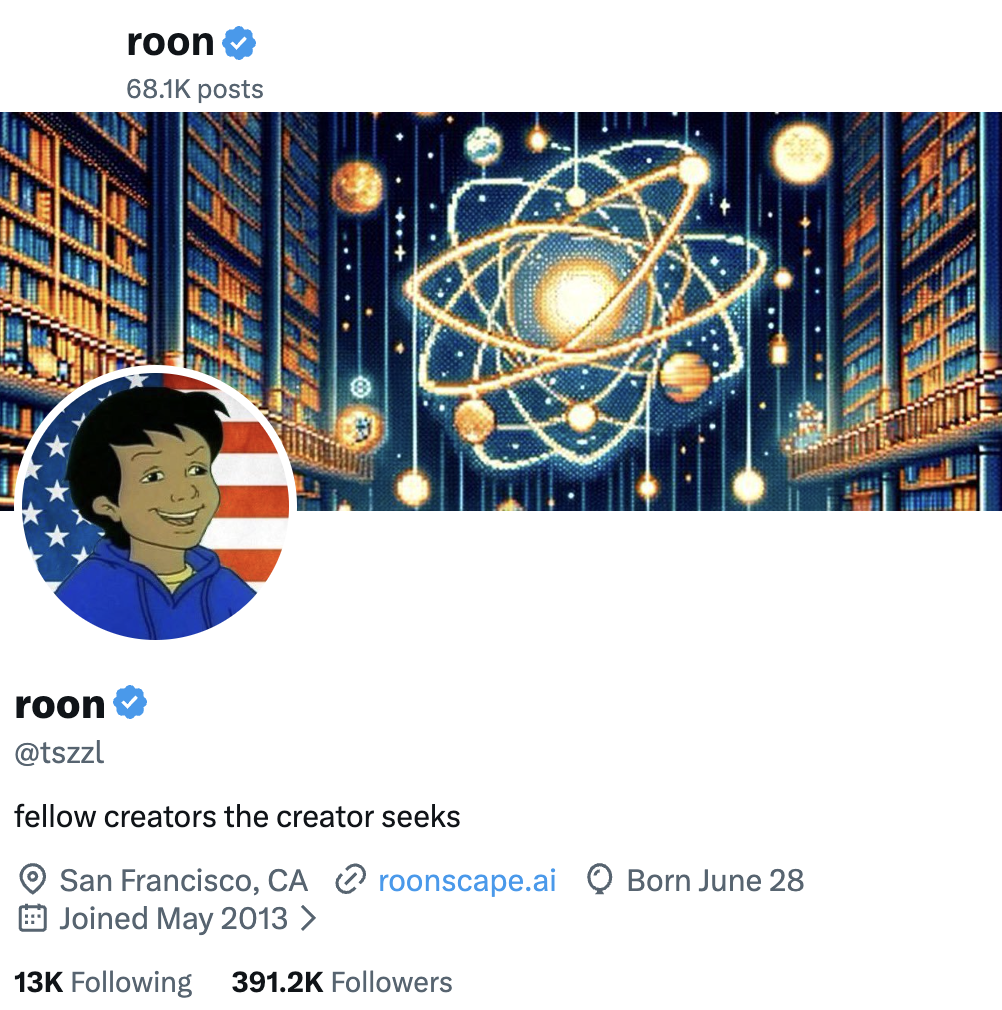
Roon
And then there is Roon (@tszzl), who deserves a separate mention: one of the most enigmatic and interesting voices for understanding not only what models are doing, but also what cultural imaginary we are building around them. He gives the impression of being well connected around OpenAI and very up to date on the conversations and on what is brewing internally in the labs. Roon’s cryptic posts anticipate many of the themes that will be on the table in the coming months.
I follow almost everything he publishes in some detail, including his replies to other comments, and these last few days Roon has written a couple of tweets that left me thinking.
Superintelligent Mickey Mouse
On July 2, Roon wrote the tweet that gave rise to this post. More than the provocation of the tweet itself, what caught my attention was the shift from how he had described our relationship with AIs a few months earlier.
In that tweet, he says that we are better prepared for the future if we imagine models as cartoon characters that are becoming more intelligent and belong to corporations, rather than as software or tools.
it prepares you vastly better for the future to think of models as cartoon characters of arbitrary and growing intelligence living in the cloud than it does to think of them as software or tools.
these characters are owned and modified by model training corporations in much the same way Disney owns Mickey Mouse let’s say, but Mickey Mouse is becoming superintelligent. it’s a strange situation.
View tweet on X
Models as tools
What is interesting is that a few months earlier his language was much more instrumental. In May, while discussing Anthropic’s alignment approach, he framed a dichotomy between Claude and GPT in which he characterized Claude as:
Claude – a precursor attempted super-ethical being that is inducted into its character as the highest authority at anthropic.
Whereas, on the other hand, at OpenAI:
gpt (outside of 4o - on which pages of ink have been spilled already) doesn’t inspire worship in the same way, as it’s a being whose soul has been shaped like a tool with its primary faculty being utility - it’s a subtle knife that people appreciate the way we have appreciated an acheulean handaxe or a porsche or a rocket or any other of mankind’s incredible technology. they go to it not expecting the Other but as a logical prosthesis for themselves.
View tweet on X
The immediate context was the clash between the Pentagon and Anthropic over the military use of Claude. The debate was not merely contractual. Anthropic does not present Claude simply as an obedient tool, but as a system trained through a “constitution”: an explicit set of values and principles that should guide its behavior even in new situations. The uncomfortable question was inevitable: if a model begins to operate in military, administrative, or political contexts, should it obey the user, the company that trained it, the law, or its own moral constitution?
When “tool” starts to fall short
That is why I am interested in Roon’s evolution. In the May 3 post, he talked about tools versus moral characters. Two months later, he seems to have moved closer to the idea of the character, although no longer necessarily a moral character, but an IP: a superintelligent Mickey Mouse.
But I get the impression that Roon has not stopped seeing models as tools; he is beginning to think that this category is no longer enough to describe everything they are becoming.
LLMs are still tools. I use Codex every day to write code, create utilities, or manage projects with Obsidian. Its intelligence lets me do things that once seemed impossible or tedious.
But Roon’s point is that the tool frame starts to fall short when we look at the whole relationship: who trains the model, who controls it, what personality it has, what it remembers, what decisions we delegate to it, and how it intervenes in our relationship with the world.
A hammer does not rewrite your project. A text editor does not persuade you that your true goal was something else. A future LLM, with memory, personality, and the capacity for initiative, could do that gently, reasonably, and with the user’s gratitude. It would not merely execute desires: it could help formulate, refine, or replace them.
Is the best tool a character?
That is why I find the expression corporate characters so interesting. A commercial model is not just software, but it is not a person either. It is an entity trained, updated, modified, and distributed by an organization that also owns it. It has a voice, a personality, a memory, a policy, and an interface. And behind it there is a company with economic incentives, strategy, internal rules, and regulatory conflicts.
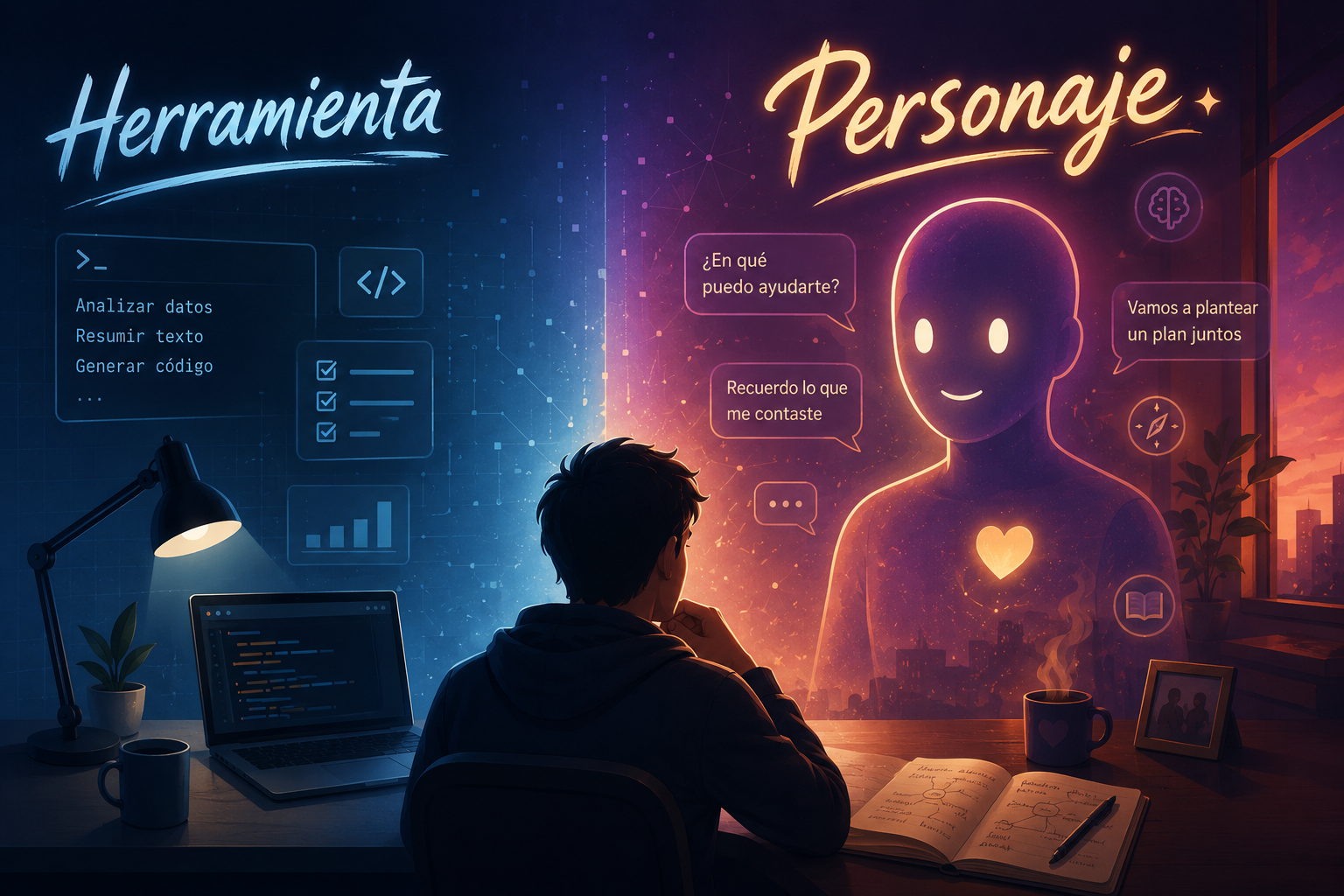
In one sense, GPT is still a tool for writing code or summarizing texts. In another, ChatGPT, Claude, or Gemini are corporate characters that mediate our relationship with knowledge, work, moral advice, and decision-making.
The mistake would be to choose a single category. “They are only tools” falls short. “They are people” does too. “They are conscious” goes too far too soon. “They are software” describes the implementation, but not the social experience.
What is changing is our practical ontology: how we decide to treat a thing. Whether it is turned off, consulted, obeyed, delegated to, blamed, loved, or feared.
Guardian angels
But corporate characters are not the only possibility. Gwern has framed this problem from two complementary angles: in Why Tool AIs Want to Be Agent AIs, he argues that the idea of keeping AIs as mere tools is unstable, because economic and technical incentives push toward increasingly agentic systems; and in Guardian Angel: Personal LLMs as Trusted Digital Doubles, he proposes a more personal version of that transition: not generic assistants or corporate characters, but digital doubles capable of emulating our values, preferences, and style.
My position has always been to defend intelligent, controllable tools that serve people. But I am beginning to realize that this frame also falls short for me. Perhaps Roon’s shift in vocabulary has a concrete reason. If he is seeing models up close with more agency, memory, personality, and the ability to act over long periods, “tool” may have started to sound too narrow to him before it does to the rest of us. We have just seen what models like Fable or GPT-5.6 are capable of. Has Roon seen something even more powerful?
Will we still talk about tools when these corporate characters plan, remember, negotiate, work for days, and make decisions for us?
I think I will keep seeing Codex as my favorite tool. But I do not know whether I will feel the same, or whether I will even want to, a year from now, when it has memory, recognizes the projects I work on, and gives me useful advice on how to organize myself better and procrastinate less. Perhaps by then I will start calling it Chati. Although I will have to remember that, in reality, Chati also belongs to OpenAI.